PROLOGUE — BLACK AS BEGINNING
It always begins with black.
Not as absence, but as origin.
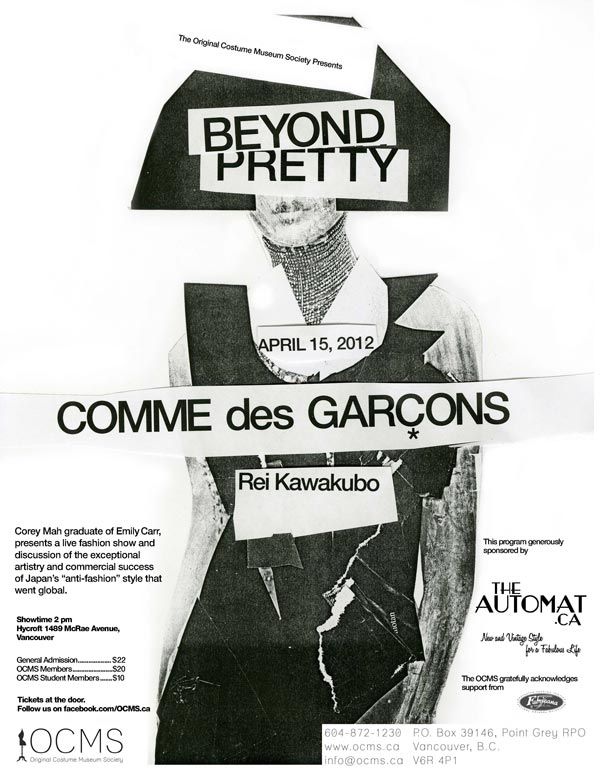
Before Comme des Garçons became a global phenomenon, before Paris bowed to Tokyo’s intellect, there was Rei Kawakubo — alone in a small room in Tokyo, scissors in hand, cutting through rules instead of fabric.
“Creation is not to make something new,” she said, “but to break something old.”
That was 1969.
And what she broke was fashion itself.
I. THE ACCIDENTAL DESIGNER
Rei Kawakubo never studied fashion.
She studied Fine Arts and Literature at Keio University — disciplines that trained her not to sew, but to see.
She began her career in advertising, styling photo shoots, learning how clothes spoke without words.
Soon, she started making her own.
Not out of ambition — out of frustration.
“I couldn’t find what I wanted to wear,” she once said.
So she made what didn’t exist.
By 1973, she had founded Comme des Garçons, borrowing its name from a French pop lyric — “like boys.”
Even the name was a contradiction: a Japanese brand with a French identity, a woman designing to dismantle gender.
II. JAPAN IN BLACK AND WHITE
Tokyo in the 1970s was a city chasing modernity — glossy, fast, full of imported ideals.
Kawakubo looked in the opposite direction.
She filled her world with asymmetry, distortion, and emptiness.
Her palette: black, grey, ivory.
Her muse: resistance.
Her clothes didn’t flatter the body; they questioned it.
They were armor for intellect, protection from conformity.
Her early followers — young, creative, defiant — wore her designs like symbols of dissent.
They were called “the Crows” for their monochrome devotion.
What others saw as bleakness, Kawakubo saw as honesty.
Beauty, she believed, was born where expectation ends.
III. 1981: WHEN PARIS TREMBLED
Paris, 1981.
The runway lights dimmed.
Then — silence.
Models drifted down the catwalk in torn black layers.
No smiles, no music, no symmetry.
The crowd sat in shock.
Some whispered “poverty.” Others, “apocalypse.”
But the world had just witnessed a revolution.
Rei Kawakubo’s Comme des Garçons debut shattered Western fashion’s obsession with perfection.
It introduced deconstruction not as aesthetic, but as emotion.
“I am not against beauty,” she said, “I am against the idea of beauty.”
Her shows were not performances — they were confrontations.
Every rip, every void, every unfinished edge was an act of philosophy.
IV. DECONSTRUCTION BECOMES LANGUAGE
By the mid-1980s, Comme des Garçons had defined a new design dialect — raw, intellectual, and deeply human.
| YEAR | COLLECTION | THEME |
|---|---|---|
| 1982 | Destroy | The poetry of imperfection |
| 1983 | Inside-Out | The anatomy of clothing revealed |
| 1986 | Body Meets Dress, Dress Meets Body | The body distorted, identity redefined |
In an era of shoulder pads and opulence, Kawakubo presented holes, padding, and asymmetry.
She made garments that questioned why clothes exist at all.
Critics called it madness.
The art world called it genius.
And so, the world began to understand that Comme des Garçons was not a brand — it was a language of rebellion.
V. 1990s — FROM FASHION TO PHILOSOPHY
The 1990s saw Kawakubo expand her philosophy beyond fabric.
She launched:
- Comme des Garçons Homme Plus — where menswear became poetic.
- Tricot Comme des Garçons — knitwear with emotion.
- Junya Watanabe Comme des Garçons — a disciple exploring technology and tailoring.
- Comme des Garçons Parfum — scents of dust, smoke, metal, and skin.
Each new project was an idea, not a product.
Her 1992 perfume smelled like tar and cloves — an anti-fragrance for the anti-fashion generation.
It didn’t attract; it provoked.
“I make clothes for the mind,” Kawakubo said. “Perfume for thought.”
Her runway shows turned into conceptual theater — surreal, emotional, and uncompromisingly abstract.
VI. 2000s — THE HEART, THE MARKET, THE WORLD
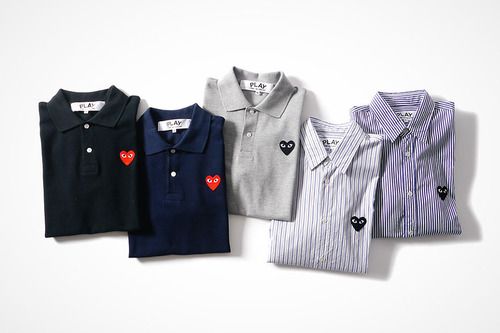
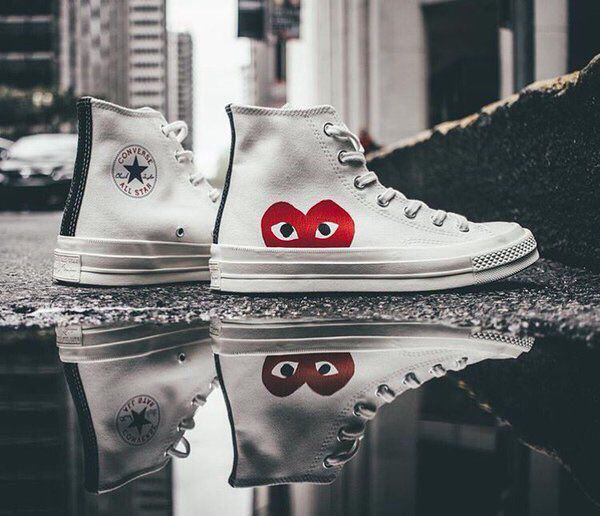
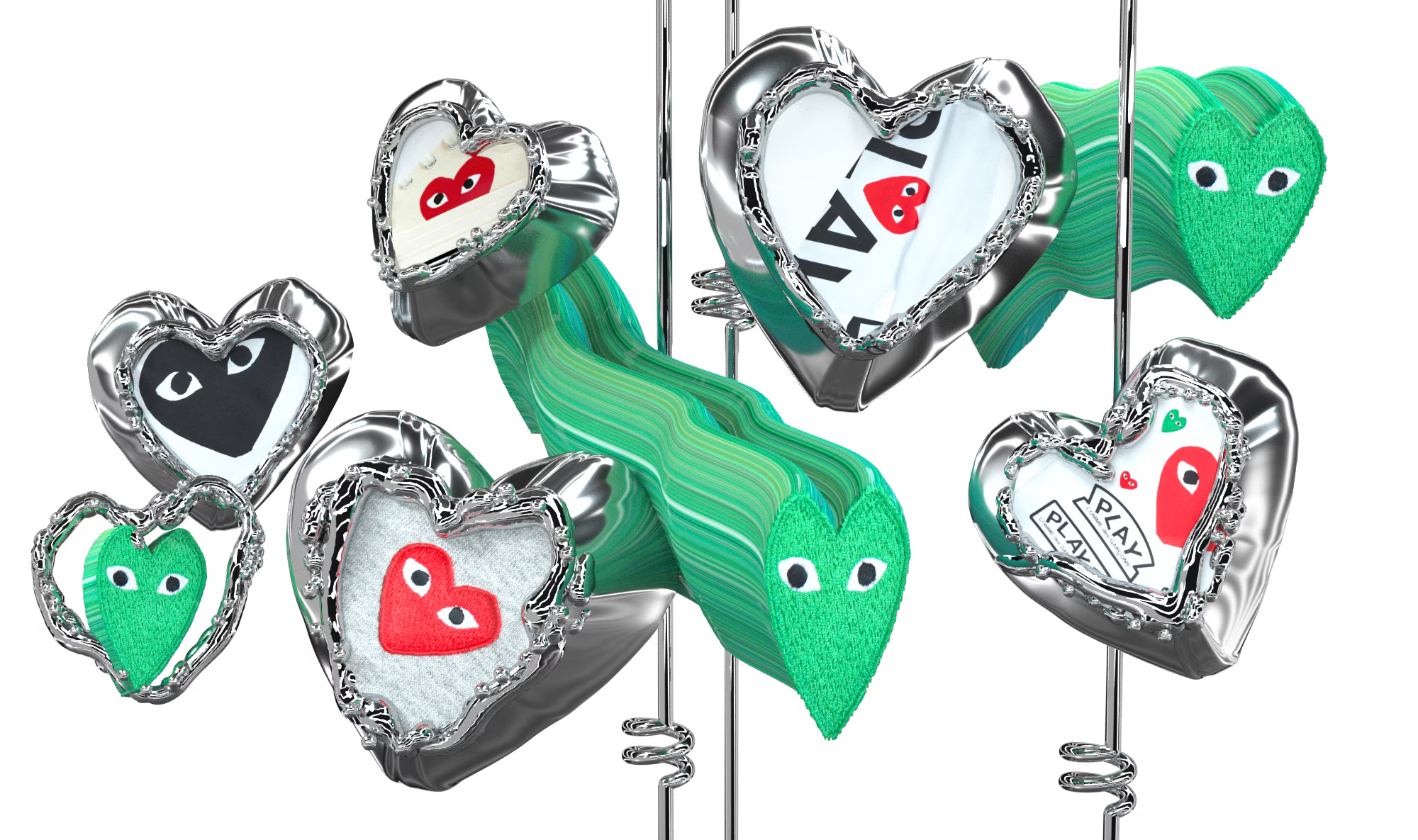
The new millennium arrived with an unexpected symbol: a red heart with eyes.
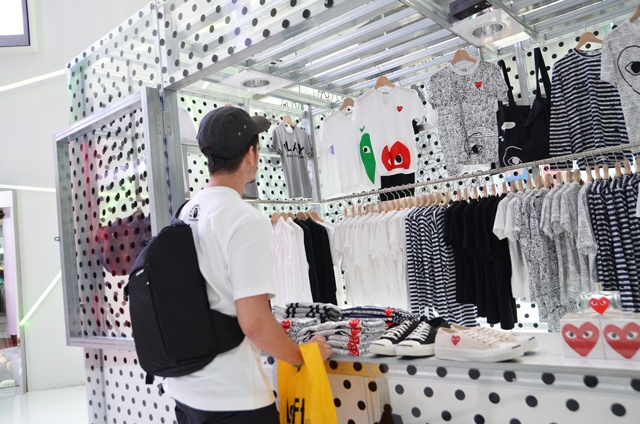
Comme des Garçons PLAY (2002) was born — accessible, playful, and instantly recognizable.
Its heart, designed by artist Filip Pagowski, became the brand’s most universal emblem.
PLAY connected intellectual fashion with global youth culture — collaborations with Converse, Nike, and BAPE brought Kawakubo’s ideology to the streets.
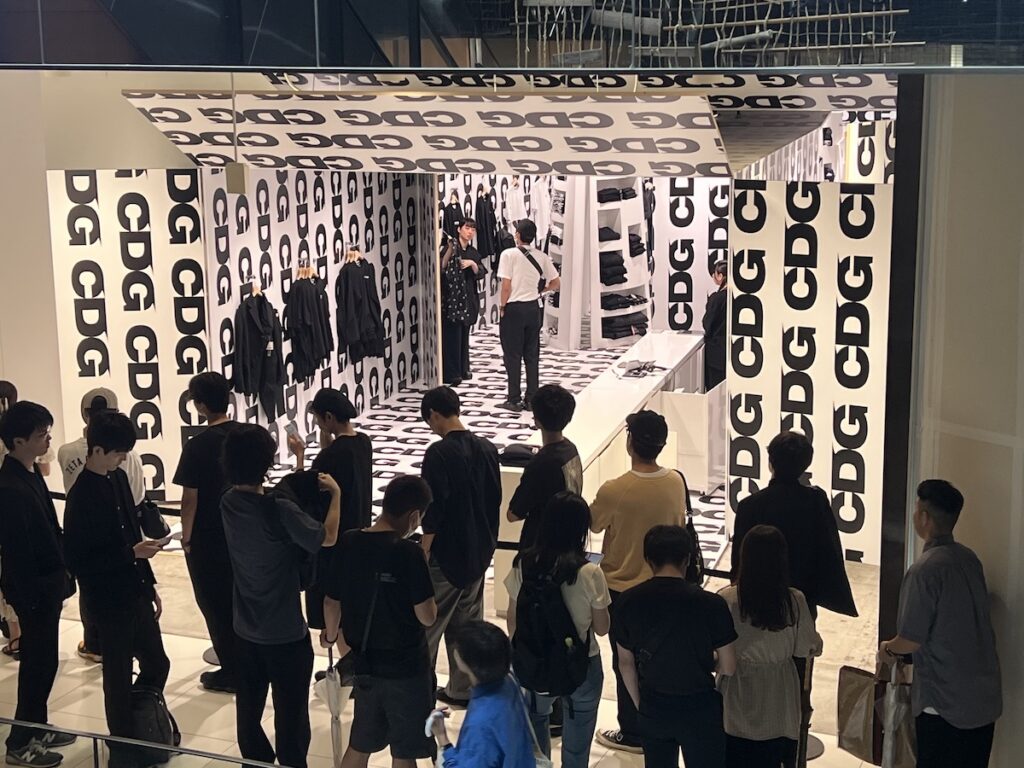
But while PLAY expanded outward, Dover Street Market (DSM) looked inward.
Launched in London (2004) by Kawakubo and her husband Adrian Joffe, DSM was more than a retail store.
It was a living organism, where brands like Gucci, Supreme, and Jacquemus coexisted in sculptural chaos.
Each floor redesigned every season — walls dismantled, installations reborn.
Kawakubo called it “beautiful disorder.”
It became the spiritual home of global avant-garde fashion.
VII. 2010s — SCULPTURE AS CLOTHING
As her peers chased commercial clarity, Rei Kawakubo moved toward abstraction.
The 2010s collections resembled art installations more than wearable fashion.
Garments ballooned into sculptures — padded, wired, or molded.
Runways became galleries.
| YEAR | COLLECTION | IDEA |
|---|---|---|
| 2012 | White Drama | The rituals of life — birth, death, marriage, transcendence |
| 2014 | Not Making Clothes | The rejection of fashion itself |
| 2017 | Art of the In-Between | Exhibition at The Met exploring duality |
In 2017, the Metropolitan Museum of Art honored Kawakubo with a solo exhibition — the first living designer since Yves Saint Laurent.
Critics called her “a philosopher disguised as a tailor.”
Every piece in that exhibit asked the same question: What is the space between?
VIII. 2020s — STILL UNTRANSLATABLE
Half a century later, Rei Kawakubo’s work remains impossible to categorize.
Her collections — Neo Future (2020), Metal Outlaw (2021), Black Rose (2023) — continue to oscillate between armor and art.
She refuses digital fame, avoids interviews, and never explains meaning.
Her Tokyo studio remains minimalist — white walls, silence, and a mannequin waiting for form.
While fashion rushes forward, Kawakubo stands still — the center of gravity.
“I don’t want to make something perfect,” she says. “I want to make something alive.”
IX. JAPAN → FRANCE — TWO WORLDS COLLIDING
Comme des Garçons is both Japanese and French — yet belongs to neither.
| ELEMENT | JAPAN | FRANCE |
|---|---|---|
| Philosophy | Wabi-sabi (imperfection) | Haute couture (precision) |
| Emotion | Restraint | Expression |
| Spirit | Silence | Spectacle |
Kawakubo doesn’t merge the two — she lets them clash.
Out of that collision emerges a new beauty: raw, fragile, transcendent.
Her move from Tokyo to Paris wasn’t a migration; it was a transformation.
She turned cultural tension into creative oxygen.
X. THE INVISIBLE WOMAN
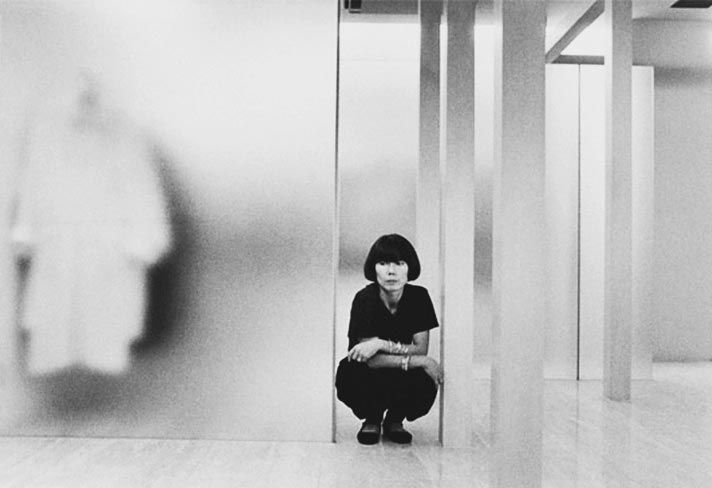
Rei Kawakubo remains an enigma — rarely photographed, seldom quoted, always present.
Behind the empire stands a woman who never chases fame, never bows to markets.
She doesn’t design for buyers, editors, or algorithms.
She designs because she must.
Her husband Adrian Joffe calls her “the most independent person alive.”
And it’s true — she has built one of the few major fashion houses that remains privately owned.
In a world run by conglomerates, that is her final rebellion.
XI. THE LEGACY THAT CANNOT BE COPIED
Fashion today is full of her ghosts:
- The deconstruction of Martin Margiela.
- The sculptural darkness of Rick Owens.
- The conceptual irony of Demna Gvasalia.
- The hybrid street couture of Virgil Abloh.
All roads lead back to Rei.
Every asymmetrical cut, every unisex silhouette, every black collection that defies beauty owes her a debt.
She didn’t just change how clothes look.
She changed how they meant.
XII. THE PHILOSOPHY OF REI
Comme des Garçons is a manifesto of contradictions:
- Destroy to create.
- Hide to reveal.
- Be silent to be heard.
- Be misunderstood to be free.
It is not a label. It is a dialogue between chaos and order, between Japan and France, between fashion and its opposite.
“My work is not about clothes,” she insists. “It’s about living.”
XIII. EPILOGUE — THE ECHO OF AN IDEA
Paris still remembers that first show in 1981 — the gasp, the confusion, the silence afterward.
But history has rewritten that moment as prophecy.
Rei Kawakubo’s journey from Japan to France was never about geography.
It was about translation — of ideas, of identity, of possibility.
Her legacy is not a collection of garments, but a constellation of questions.
And those questions — about beauty, imperfection, power, and individuality — still guide the fashion world like stars.
She remains what she always was:
a designer of thoughts,
a poet of form,
a shadow that illuminates.